Choosing a roof for your pergola is really choosing how you want to live outdoors. Do you want a space that opens up completely on a warm evening, one that adjusts to whatever the British weather throws at it, or one that simply gets on with the job of keeping you dry, no fuss required?
That decision usually comes down to three roof philosophies: retractable, louvred (tilting), and fixed. Each has genuine strengths, and the "best" one depends entirely on how you use your garden. In this guide, we'll unpack how a retractable pergola roof actually works, how it compares to louvred and fixed designs, what it costs in the UK, and how to work out which one is right for you, drawing on SOLA's own aluminium pergola range throughout.
A retractable pergola roof is exactly what it sounds like: a roof designed to open and close, rather than sit fixed in one position. Instead of tilting individual slats to filter light (as a louvred system does), a retractable roof slides or gathers back on itself, so a large section of the roof genuinely disappears, opening the space up to the sky.
That's a meaningfully different idea to a tilting louvre roof. A tilting system is built around adjustment: you angle the louvres to let in a little light or a lot, or close them fully to shed rain. A retractable system is built around disappearance: rather than fine-tuning the angle, you're choosing between an open sky and a closed, weatherproof roof, with a smooth motorised glide between the two.
On SOLA's own retractable pergola range, this is described as a "streamlined, elegant solution for those who want flexible overhead coverage without the complexity of tilting systems." It's a fair summary: fewer moving parts doing one job well, rather than many parts doing lots of jobs.
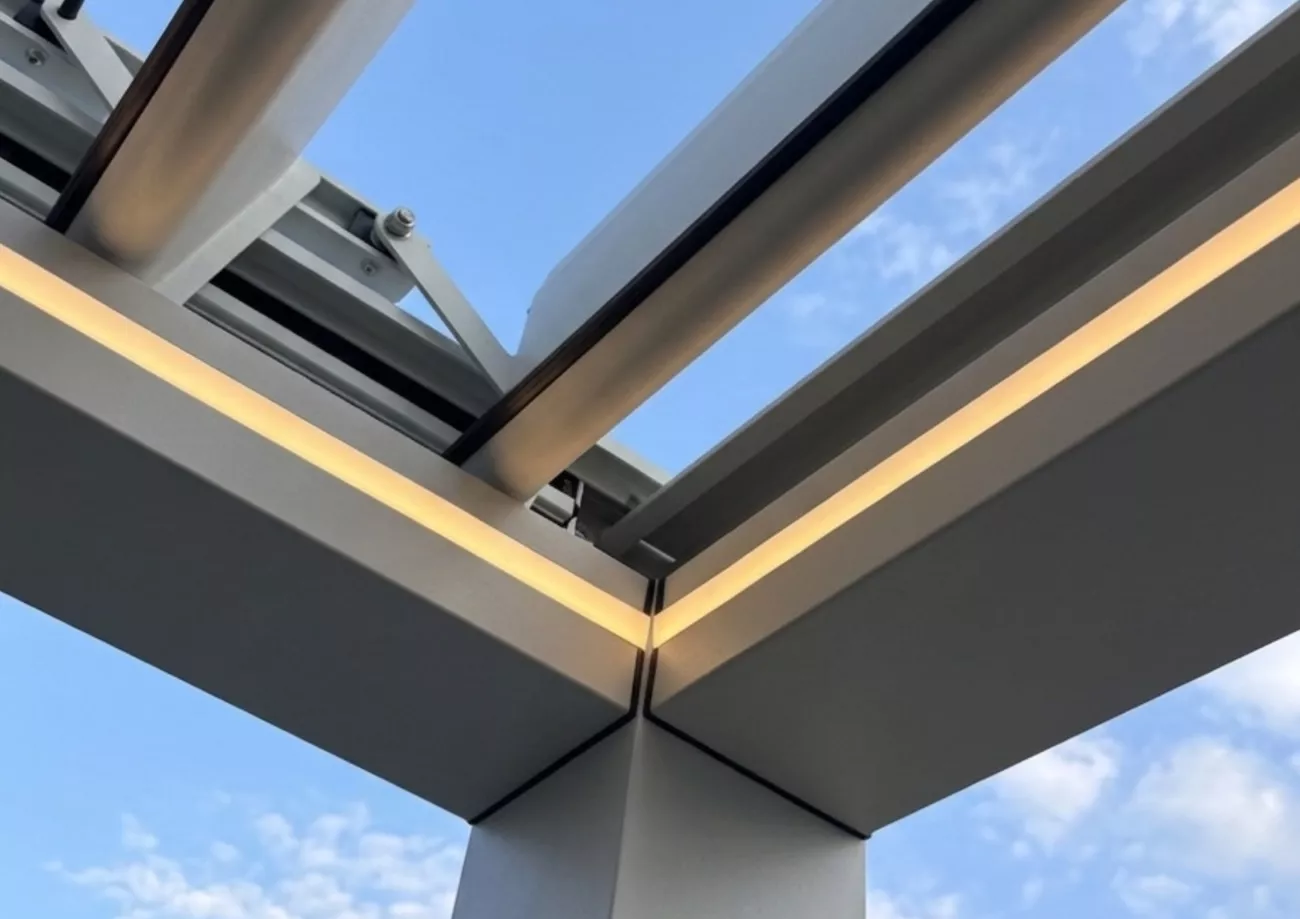
Rather than a fabric canopy on a wire (the sort you might picture on a caravan awning), a genuine aluminium retractable pergola roof uses rigid, colour-matched aluminium louvre panels that glide back along a track built into the frame, gathering neatly at one end of the structure. Because the panels are aluminium rather than fabric, you get the durability of a solid roof when it's closed, with the option of an open sky when it isn't.
Two models within the SOLA range use this exact approach:
You'll often see "retractable," "louvred," and "tilting louvre" used almost interchangeably online, and it's easy to see why: several manufacturers use motorised aluminium louvre panels for both tilting and retracting systems. The distinction that actually matters is functional, not terminological:
Both are motorised, both are aluminium, and both are genuinely weatherproof when closed. The difference is what happens when you want maximum openness: a tilting system opens the slats to let light and air through the gaps, while a retractable system removes the roof from view entirely.
Pros
Cons
Pros
Cons
Pros
Cons
Laid out side by side, the differences come down to a handful of everyday factors. On sun and shade control, a fixed roof offers none, since the shade it provides is permanent, while a retractable roof gives you a straightforward choice between fully open and fully closed, with little middle ground. A louvred, tilting roof sits at the flexible end of the scale, letting you dial in any angle you like between the two extremes.
Open-sky access follows a similar pattern. You'll never get a clear view of the sky through a fixed roof, and even a fully open louvred system leaves the slats visible overhead. A retractable roof is the only option that genuinely clears the space, with SOLA's own models opening up to 75–80% of the roof area.
All three handle rain equally well once closed, thanks to integrated drainage built into the frame, so this isn't a deciding factor on its own. Ventilation is where they start to differ again: a fixed roof relies solely on open sides for airflow, a louvred roof lets you fine-tune ventilation via the angle of the slats, and a retractable roof offers the best airflow of all simply because the roof itself is out of the way.
Aesthetically, a fixed roof gives a solid, architectural look, a retractable roof reads as clean and minimalist when open, and a louvred roof has a sleek, contemporary, slatted appearance whatever position it's in. Maintenance is minimal on a fixed roof, since there's nothing to move, while both retractable and louvred systems benefit from an occasional check of the motor and track. In terms of everyday use, fixed roofs suit outdoor kitchens and spaces wanting permanent shelter, retractable roofs suit gardens and terraces where an open-sky feel matters, and louvred roofs suit entertaining spaces where precise daily adjustment is the priority.
Yes. Provided you're looking at a genuine aluminium retractable roof rather than a fabric canopy, closing the roof creates a solid, weatherproof surface. On the SOLA Sky and SOLA Prestige, rainwater is channelled through integrated gutters built into the roof structure and directed down through the frame, so you're not left with water pooling on top or dripping over the edge.
Where it's worth being precise: "retractable" isn't the same thing as "fabric." A pull-across fabric canopy will sag and pool under sustained rain, which is why it's usually recommended you retract fabric systems before a downpour. A rigid aluminium retractable roof does the opposite: you close it specifically because rain is coming, and it's designed to handle that, in the same way a fixed or louvred roof is.
Pricing for a retractable pergola in the UK depends heavily on size, colour options and how much of the roof genuinely retracts. As a guide, SOLA's own retractable range starts from around £12,349 for the SOLA Sky in a single structure, with the SOLA Prestige positioned above this as a fully bespoke, modular option, since its pricing depends on the size and configuration you choose.
A few things that move the price:
The most reliable way to get an accurate figure for your own garden is to build your specification using the SOLA Configurator, which gives you a tailored price based on your exact size, colour and feature choices, or to download the latest brochure for full range pricing.
Rather than picking a roof from a spec sheet, it helps to think about how you actually use your garden.
Choose a fixed roof if you want permanent, reliable shade and shelter, you're not fussed about opening the roof up on sunny days, and you'd rather have zero moving parts to think about.
Choose a retractable roof if you love the idea of an open-sky garden on warm days, but want the reassurance of a solid, weatherproof roof at the touch of a button when the weather turns. It suits anyone who wants their pergola to feel less like "a covered patio" and more like an outdoor room that can open up completely.
Choose a louvred (tilting) roof if you want the finest possible day-to-day control, tilting the roof to exactly the angle that suits the light, heat or breeze at that moment, and you're happy for the slats to remain part of the view even when fully open.
All three are available across our aluminium pergola range, built from durable, low-maintenance aluminium and backed by SOLA's warranty, so whichever roof style suits your garden, you're not compromising on build quality to get it.
Yes, when built from aluminium rather than fabric. A quality retractable roof, like the SOLA Sky or SOLA Prestige, forms a solid, weatherproof surface when closed, with integrated guttering to manage rainwater.
Yes. SOLA's retractable models use Somfy motorised systems controlled via remote or app, so opening and closing the roof takes seconds rather than manual effort.
A louvred roof stays in place and tilts its slats open or closed. A retractable roof physically slides the panels back, so a large section of the roof opens completely, giving a more uninterrupted view of the sky than a tilting system.
In most cases, a pergola falls under permitted development if it's under 2.5 metres high within 2 metres of a boundary and your property isn't listed or otherwise restricted. Rules vary by local authority, so it's always worth checking with your council before installation.
Built from aluminium rather than fabric or timber, a well-made retractable roof should last for many years with minimal upkeep, occasional cleaning and a periodic check of the motor and track being all that's typically required.
Specification sheets only tell you so much. If you're weighing up a retractable roof against a louvred or fixed design, the easiest way to decide is to see and operate one for yourself. Start building your own specification with the SOLA Configurator, or explore the SOLA Sky and SOLA Prestige in full detail to see which retractable design suits your outdoor space.